
.png)
Our Story
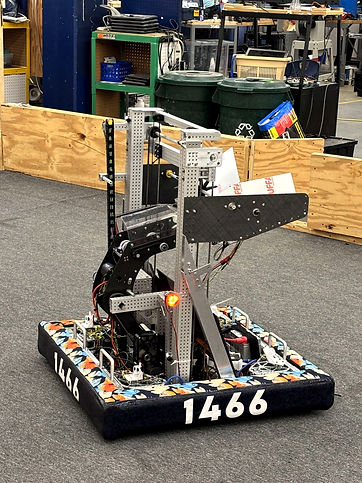
When Webb Robotics was founded in 2004, it was to meet a need for STEM opportunities in our community. As the oldest FIRST Robotics Competition (FRC) team in East Tennessee, we had no blueprint – no example of inspiring STEM programs to guide us.
As an alumnus recently recounted, our team founder had to “‘fight for robotics’ inclusion before STEM was considered a critical part of the school curriculum.” Over the last two decades, our team has grown and thrived, honing our problem-solving skills and developing a model for our team and others to follow. As new challenges emerge, we remain ready and responsive, tackling needs both big and small, local and global.
Our team has won more than these two great victories, however. As one anonymous team member noted, "The FIRST program has made me appreciate robotics more than I used to, and it has also taught me the importance of teamwork... I love being part of such a hardworking and intelligent team, and I have definitely learned a lot from my fellow teammates."
Each year, team 1466 participates in the FIRST Robotics Competition (FRC) by building a robot for a specific task during a fixed six week period. In 2026, we are launching our new sister team, 1445. We also are proud to have both an FTC team, 9934, and multiple FLL teams, 5358, 51985, and 59099. Visit our page about FIRST to learn more about the competitions and its organization.
Mechanics:
The mechanical team is responsible for the primary design, prototyping, and building of the final robot based on the designs in CAD. This team is the largest sub-group of team 1466. Mechanical captain Evan Davies describes his role: "My role is vital in converting the robot from a pile of scrap to a pile of not scrap."
Business:
The business manages our funding and finances. They acquire sponsors so that the team has enough money to build a robot and enter regionals. Then, they budget how much money is available to be spent and make decisions about the most efficient ways to spend money and where to order parts from. They also play a large role in PR.
Code:
The code designed by our team allows our robot to move around and interact with the elements of the field. The code is vital to the robot's ability to perform the functions it is designed for. They work with the other members of the team to make a robot that will do what is needed in the field. Sometimes, the code team will work with everyone else on a project essential to the robot, even if it isn't programming.
CAD:
CAD stands for Computer Aided Design, which is used for designing the robot. As soon as the challenge is announced, this sub-team works on potential designs for the new season's robot. This process comes before prototyping to save massive amounts of time, effort, and money. Once the design is finalized, the CAD team works with mechanics to sync up the plans. From then on, the CAD team assists in ensuring the dimensions and properties of the robot are accurate to the design. CAD lead Spencer Williams says, "The CAD team is like a box of chocolates-- you don't want to be a robotics team without it."
Electronics:
The electronics team assembles components utilized by the code team for the articulation of the robot. This team decides how to make sure the electric charge reaches parts of the robot when desired. It is the smallest sub-group, tied with code, but it is crucial to the robot running. Electronics head Rachel Anderson says, "With extra effort, an electronics board can go from making your robot go up in flames (literally) to unlocking a robot's full potential."
The media team is responsible for our whole online presence. They take charge posting weekly recaps, carousels and viral Reels on Instagram (Check out our Photos page!), and more. They are vital to the team's success and documentation, and are likely the reason that you know the classic name of Webb Robotics Team 1466.